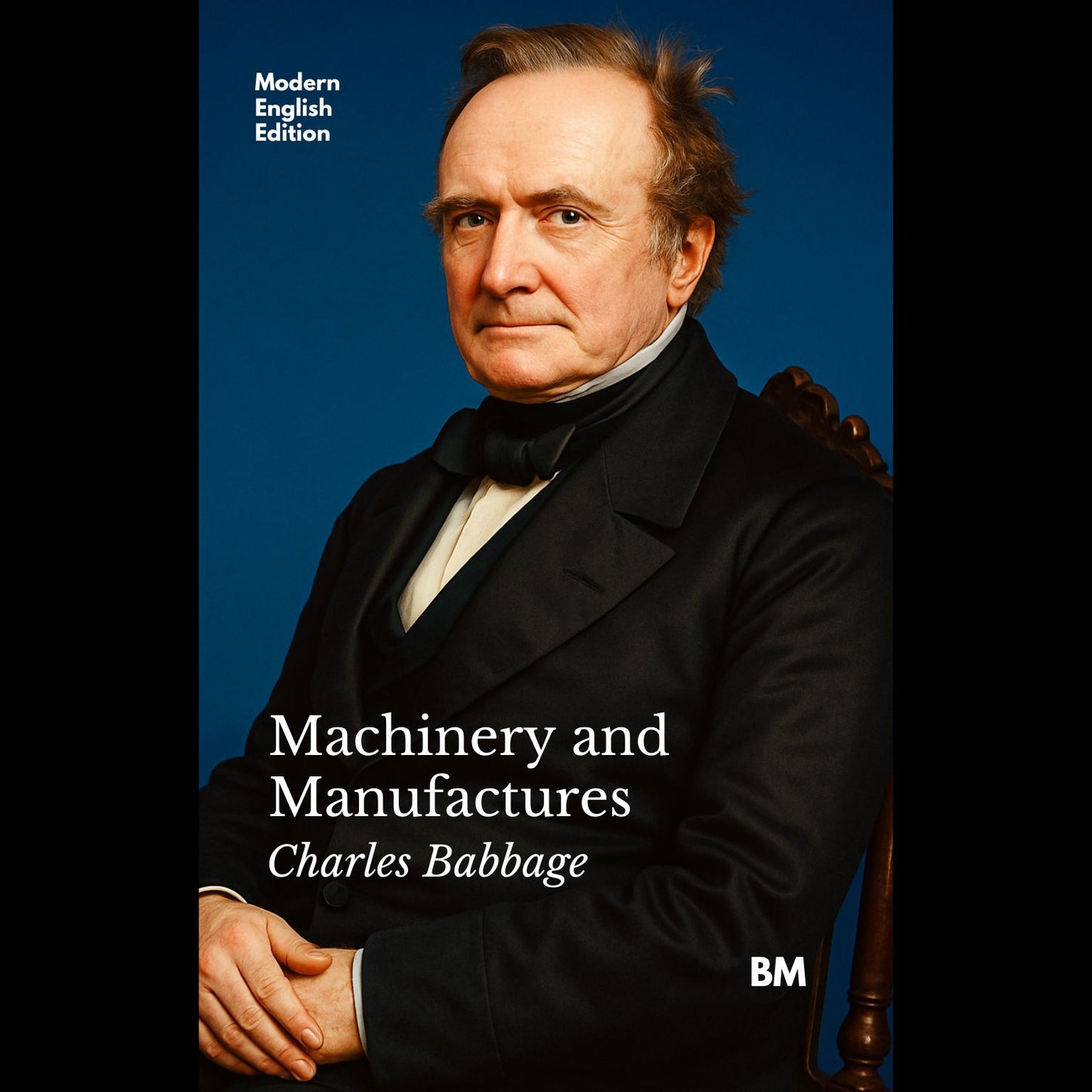
Machinery and Manufactures
Machinery and Manufactures
Couldn't load pickup availability
Charles Babbage’s On the Economy of Machinery and Manufactures is one of the earliest and most penetrating books on industrial organization. Written in 1835, at the height of the first Industrial Revolution, it moves beyond abstract theory to examine factories, tools, labor, time, costs, and the practical advantages of dividing work into specialized operations. Babbage is at once observant, analytical, and intensely concrete, explaining how manufacturers decide what to mechanize, why precision matters, and how productive systems are built from many small efficiencies. This work stands out not as a broad philosophical essay on industry, but as a detailed investigation of the mechanics of production itself. It is especially valuable for readers interested in the roots of modern management, operations, and industrial economics. This edition presents the work in clear modern language while preserving the substance, structure, and force of the original.
Why it still matters
Babbage’s discussion of efficiency, specialization, automation, and the relationship between labor and machinery still speaks to modern manufacturing, supply chains, operations management, and the economics of automation. Readers interested in lean production, process design, or the historical roots of industrial engineering will find surprisingly current insights in his practical approach to how work is organized and improved.
What makes this edition distinctive
Unlike many classic economic texts that argue in broad theory, this book is grounded in the mechanics of actual production. Babbage writes as an analyst of workshops and factories, focusing on the hidden structure of manufacturing: task decomposition, machine design, precision, waste reduction, and the measurable value of time and skill. Its blend of technical detail and economic reasoning makes it unusual among early industrial-era works.
Who this is for
This book will appeal to readers of economic history, industrial history, business history, and the history of technology, especially those who want to understand how modern manufacturing thinking began. It is also a strong fit for engineers, operations-minded readers, and anyone curious about the origins of ideas that still shape production, automation, and organizational efficiency today.
Historical context
First published in 1835, this work emerged during Britain’s rapid industrial expansion, when steam power, mechanized textile production, and factory discipline were transforming labor and commerce. Babbage drew on direct observation of workshops and industrial processes, producing one of the earliest systematic studies of manufacturing organization.