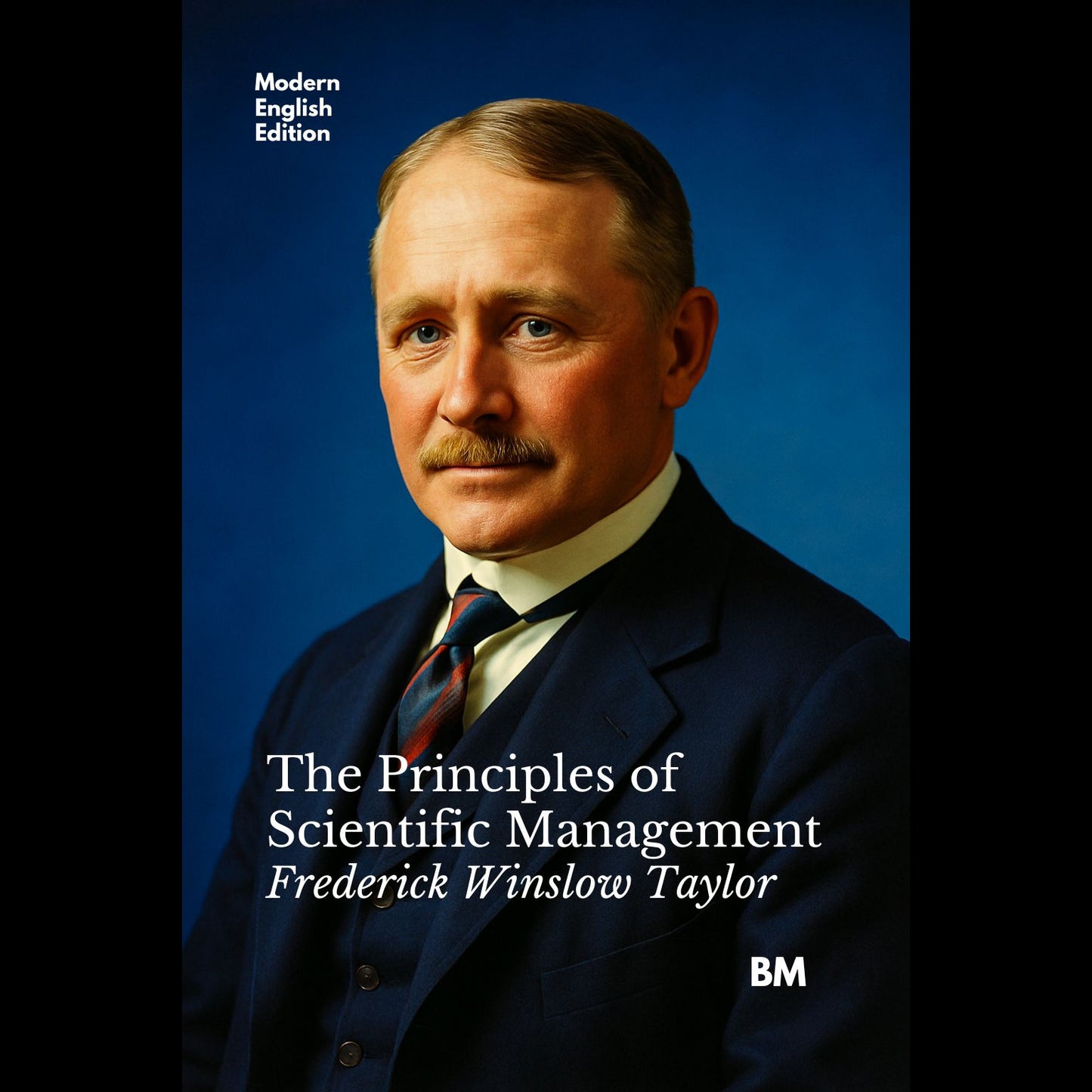
The Principles of Scientific Management
The Principles of Scientific Management
Couldn't load pickup availability
The Principles of Scientific Management is Frederick Winslow Taylor’s foundational statement of the ideas that came to be known as scientific management, or Taylorism. Drawing on factory observation, time studies, and experiments in labor organization, Taylor argues that both manual work and supervision should be approached as problems of method rather than habit or guesswork. He lays out a case for standardizing tasks, selecting and training workers systematically, and dividing responsibility between management and labor in a new way.
What makes the book distinctive is its practical, argumentative style: Taylor does not write abstract theory so much as he builds a case from examples, case studies, and industrial results. The text is historically important because it helped shape modern management, operations, and productivity thinking, while also sparking long-running debates about efficiency, labor autonomy, and the human costs of mechanized systems.
This edition presents the work in clear modern language while preserving the substance, structure, and force of the original.
Why it still matters
Taylor’s ideas remain relevant anywhere organizations seek to improve productivity, reduce waste, or design repeatable processes, from manufacturing and logistics to software operations and service work. Even when readers disagree with his assumptions, the book remains important for understanding the origins of workflow analysis, performance measurement, and the managerial pursuit of efficiency that still shapes modern workplaces.
What makes this edition distinctive
Unlike broader business or economics classics, this book is narrowly focused on the practical redesign of labor itself. Taylor writes with a workshop engineer’s mentality, using observation, measurement, and concrete examples to argue that management should become a disciplined science. Its influence is enormous not because it offers inspirational leadership advice, but because it proposes a systematic method for extracting more output from organized work.
Who this is for
This book will appeal to readers interested in the history of management, industrial engineering, operations, labor studies, and the roots of productivity culture. It is also useful for business readers who want to understand where modern efficiency methods came from, and for general readers who are curious about the ideas that transformed factories, offices, and organizational thinking in the twentieth century.
Historical context
Published in 1911, this book emerged during the height of industrialization in the United States, when factory production, mass manufacturing, and labor specialization were rapidly expanding. Taylor’s work became a cornerstone of early twentieth-century management theory and influenced both the rise of modern corporate organization and the later backlash against mechanized approaches to human labor.